What is the duty of candour, and what does it mean for a clinical negligence claim?
The duty of candour requires health and care providers in England to tell patients about notifiable safety incidents, explain the facts and apologise. This guide covers what regulation 20 requires, what counts as a notifiable incident, and how claimant solicitors can use the candour record on a clinical negligence file.

The duty of candour is the legal duty on health and care providers in England to be open with patients when care goes wrong. Under regulation 20 of the Health and Social Care Act 2008 (Regulated Activities) Regulations 2014, a provider must tell the patient about a notifiable safety incident in person, give a true account of the facts, apologise and follow up in writing.
- It binds every provider registered with the Care Quality Commission (CQC), NHS and private, and sits alongside a separate professional duty on individual clinicians.
- The formal steps are triggered by a notifiable safety incident: something unintended or unexpected that caused, or could cause, death or a defined level of harm.
- An apology given under the duty is not, of itself, an admission of negligence.
- For a claimant firm, the candour record is evidence: what the provider knew, when it said so and what it promised to investigate.
- A missing or late notification does not prove negligence, but it is a question worth asking of every clinical negligence file.
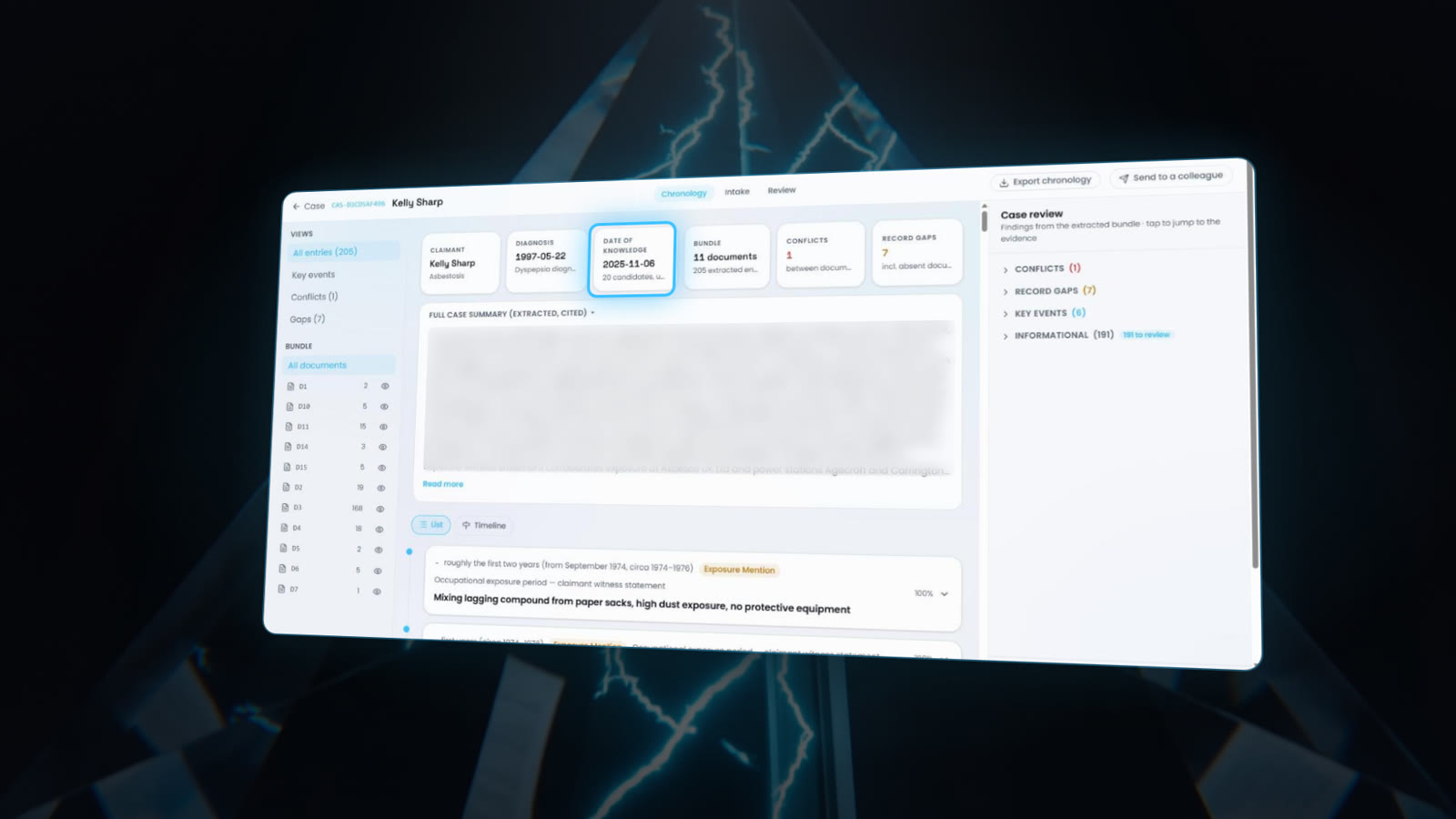
I built Plexo Legal, case analysis software for UK claimant law firms, and one of its tools audits the medical record against this duty. Below I go through the duty as the regulation sets it out, and then how a clinical negligence team can use it when reviewing a file.
Where does the duty of candour come from?
The statutory duty of candour comes from regulation 20 of the Health and Social Care Act 2008 (Regulated Activities) Regulations 2014. Its first paragraph sets the general rule: registered persons "must act in an open and transparent way with relevant persons in relation to care and treatment". The rest of the regulation sets out, step by step, what a provider must do when a notifiable safety incident happens.
According to the CQC's guidance on regulation 20, the duty "applies to every health and social care provider that CQC regulates". That covers NHS trusts, GP practices, independent hospitals, private clinics, dental practices and care homes in England.
There are actually two duties of candour, and claimant solicitors come across both:
| Statutory duty of candour | Professional duty of candour | |
|---|---|---|
| Who it binds | Registered providers and registered managers (the organisation) | Individual doctors, nurses, midwives, dentists and other registered professionals |
| Where it is set out | Regulation 20 of the 2014 Regulations | The professional standards of each health regulator |
| Who oversees it | The Care Quality Commission | The General Medical Council, Nursing and Midwifery Council, General Dental Council and other regulators |
| When a notifiable safety incident happens | Specific steps: in-person notification, apology, written follow-up and records | Not enough on its own to meet the statutory duty, as the CQC's guidance points out |
Wales has its own statutory duty of candour for NHS bodies, under Part 3 of the Health and Social Care (Quality and Engagement) (Wales) Act 2020, in force since 1 April 2023. This guide deals with regulation 20 in England.
What counts as a notifiable safety incident?
A notifiable safety incident is an unintended or unexpected incident during regulated care that, in the reasonable opinion of a health care professional, caused or could cause death or a defined level of harm. The CQC breaks it into three questions: did something unintended or unexpected happen, did it happen while a regulated activity was being provided, and has it resulted in death or the level of harm the regulation sets out?
The harm test depends on who provided the care. For an NHS body (a "health service body"), regulation 20(8) covers incidents that could result in, or appear to have resulted in, death, severe harm, moderate harm or prolonged psychological harm. For any other provider, regulation 20(9) uses a different list, including an impairment lasting at least 28 days, changes to the structure of the body, prolonged pain or psychological harm, a shortened life expectancy, or treatment needed to prevent death or serious injury.
Regulation 20(7) defines the key terms, and these are the definitions to hold a file against:
| Term | What regulation 20(7) says it means |
|---|---|
| Moderate harm | Harm that requires a moderate increase in treatment, and significant but not permanent harm |
| Moderate increase in treatment | An unplanned return to surgery, an unplanned re-admission, a prolonged episode of care, extra time in hospital or as an outpatient, cancelled treatment, or transfer to another treatment area such as intensive care |
| Severe harm | A permanent lessening of bodily, sensory, motor, physiologic or intellectual functions, including removal of the wrong limb or organ or brain damage, related directly to the incident |
| Prolonged psychological harm | Psychological harm experienced, or likely to be experienced, for a continuous period of at least 28 days |
| Prolonged pain | Pain experienced, or likely to be experienced, for a continuous period of at least 28 days |
Fault plays no part in the test. The CQC's worked examples include a patient who suffered a stroke during a bypass operation carried out exactly to plan: a death, but not a notifiable safety incident, because nothing unintended or unexpected occurred. It works the other way too: an incident can be notifiable without anyone having been negligent. Notification is about openness, and it says nothing either way about blame.
What must a provider do after a notifiable safety incident?
As soon as reasonably practicable after becoming aware of a notifiable safety incident, the provider must tell the patient, or the person lawfully acting for them, and support them through it. Regulation 20 sets out each step:
- Notify in person. One or more representatives of the provider tell the relevant person that the incident has occurred.
- Give a true account. The notification gives an account, true to the best of the provider's knowledge, of all the facts it knows about the incident at that date.
- Explain the next enquiries. It advises what further enquiries the provider believes are appropriate.
- Apologise. It includes an apology, defined as "an expression of sorrow or regret".
- Record it. The notification is recorded in a written record that the provider keeps securely.
- Follow up in writing. A written notification follows, repeating the account, detailing the enquiries, giving the results of those enquiries and apologising again.
- Keep the correspondence. The provider keeps a copy of all of it. If the person cannot be contacted or declines to speak, the provider keeps a written record of its attempts instead.
The "relevant person" is usually the patient. It is someone lawfully acting on their behalf if the patient has died, is under 16 and not competent to decide, or is 16 or over and lacks capacity. Under regulation 22, failing to comply with the notification requirements in regulation 20(2)(a) and (3) is a criminal offence.
Is an apology under the duty of candour an admission of liability?
No. Section 2 of the Compensation Act 2006 is explicit: "An apology, an offer of treatment or other redress, shall not of itself amount to an admission of negligence or breach of statutory duty." The CQC's guidance makes the same point, and NHS Resolution's Saying sorry leaflet tells NHS staff that apologising is not an admission of liability.
So a candour apology shouldn't be read as a concession. What the letter can give you is the provider's own account of the facts, its list of enquiries and, later, the results of those enquiries, in writing and dated. On a claimant file that's usually worth more than the apology.
Why does the duty of candour matter in a clinical negligence claim?
The candour record is often the first thing the provider puts in writing about what went wrong. On a claimant file it can help in four ways.
- The facts. The account must cover all the facts known at the date of notification. Set it against the medical records and any later investigation report, and the differences between the three versions are often where the case is.
- The timing. The date the provider became aware of the incident and the date it told the patient both belong in the chronology. The date a client first learned that their injury may have been caused by something that went wrong can also bear on their date of knowledge under section 14 of the Limitation Act 1980 (the rule that starts the limitation clock when the claimant knew, or could reasonably have known, the relevant facts).
- The gaps. Where a serious, unexpected harm sits in the records with no candour notification anywhere, that is a question to put to the defendant, and a reason to ask for the written record and correspondence the regulation requires the provider to keep.
- The consent picture. Candour looks at what the patient was told after the event. Consent looks at what they were told before it. Since Montgomery v Lanarkshire Health Board [2015] UKSC 11, doctors must take reasonable care to make sure patients are aware of material risks. Reviewing both together shows the whole story of what the patient knew and when.
A word of caution, though. A breach of regulation 20 is a regulatory matter for the CQC. It does not, on its own, establish breach of duty or causation in negligence, which still have to be proved on the clinical evidence and expert opinion.
How do you audit a medical record for candour?
A candour audit tests the record against each step of regulation 20 and lists, with references, what is there and what is missing. Done by hand on a large bundle it's slow, because the evidence is spread across ward notes, incident reports, letters and complaint responses. The usual order of work is:

- Identify the incident and its date from the chronology.
- Decide which harm test applies, regulation 20(8) for an NHS body or 20(9) for any other provider, and whether the threshold looks met.
- Find the in-person notification, its date and who gave it, and measure the gap from the date the provider became aware.
- Check its content: an account of the facts, the further enquiries planned and an apology.
- Find the written follow-up and the results of the enquiries.
- Compare the provider's account with the contemporaneous records and list every contradiction.
- List what is missing and request it.
How Plexo Legal's Consent and Candour Audit works
Plexo Legal's Consent and Candour Audit tests the record against informed consent and each step of the statutory duty of candour, with every gap cited. It runs on the cited chronology that Plexo Legal's Medical Record Intelligence builds from the whole bundle, so each finding points to the page it came from and can be checked in seconds. Pages the system cannot read with confidence go to a person, rather than being guessed.
What you get is a cited audit to put to the expert: which steps of regulation 20 are evidenced, where, and which are missing. Like everything in Plexo Legal, it stays a draft until a fee earner approves it. You can watch the tool in action in the film at the top of this page, see how it fits the rest of the clinical negligence workflow on our clinical negligence page, and read how the underlying chronology is built in What is medical chronology software?
What to do next
On every clinical negligence file where something unexpected happened, treat candour as a standard line of enquiry: ask whether the incident was notifiable, find the notification and the follow-up, and set the provider's account against the records. If you'd like to see a candour audit run on a bundle like yours, book a live demo and I'll walk you through it. The full product, including how it handles security and client data, is on the Plexo Legal page.
Frequently asked questions
What is the duty of candour in simple terms?
It is the legal duty on health and care providers in England to be open and honest with patients about their care. When a notifiable safety incident happens, the provider must tell the patient in person, explain what it knows, say what it will investigate, apologise, and then confirm all of this in writing.
Who does the duty of candour apply to?
The statutory duty applies to every health and social care provider registered with the Care Quality Commission, including NHS trusts, GP practices, independent hospitals, dentists and care homes. Individual clinicians are separately bound by a professional duty of candour set by their own regulators, such as the GMC and NMC.
What is a notifiable safety incident?
It is an unintended or unexpected incident during regulated care that, in a health care professional's reasonable opinion, caused or could cause death or a defined level of harm. The exact harm thresholds differ for NHS bodies and other providers and are set out in regulation 20(8) and (9).
Is a duty of candour apology an admission of liability?
No. Section 2 of the Compensation Act 2006 says an apology does not of itself amount to an admission of negligence or breach of statutory duty. The account of facts that accompanies the apology can still be valuable evidence on a claimant file.
Does a breach of the duty of candour prove clinical negligence?
No. The duty of candour is enforced by the CQC, and failing to notify can be a criminal offence under regulation 22. A negligence claim still has to prove breach of duty and causation on the clinical evidence. A candour failure gives you questions to ask and documents to request, but it won't prove the claim on its own.
How quickly must a provider notify the patient?
Regulation 20 says "as soon as reasonably practicable" after the provider becomes aware of the incident. It does not set a number of days, so the gap between awareness and notification has to be judged on the facts of each case.
Does the duty of candour apply in Wales?
Regulation 20 applies to providers registered with the CQC in England. NHS bodies in Wales are under their own statutory duty of candour, introduced by Part 3 of the Health and Social Care (Quality and Engagement) (Wales) Act 2020 and in force since 1 April 2023.
The duty exists to make care more open, and along the way it leaves a dated paper trail that's worth reading closely on any claimant file. If you'd like to see the audit run on a bundle of your own, book a live demo.
Sources and references
- 1.
- 2.
- 3.Regulation 20: Duty of candour(Care Quality Commission, updated 16 May 2025)
- 4.Examples of notifiable safety incidents(Care Quality Commission)
- 5.
- 6.Saying sorry (duty of candour)(NHS Resolution)
- 7.
- 8.Montgomery v Lanarkshire Health Board [2015] UKSC 11(UK Supreme Court, 11 March 2015)
- 9.Limitation Act 1980, section 14(legislation.gov.uk)

Diego builds Plexo Legal, AI case analysis software for UK claimant law firms. He is trained and certified in AI through Google and Anthropic. About Plexo Logic →
See a real bundle analysed, live.
Cited chronologies, case triage and limitation, run on a file while you watch.
Book a live demo