How should UK law firms use AI under SRA rules?
The SRA lets law firms use AI, but the solicitor stays accountable for every output. This guide covers the SRA's August 2026 warning notice, the Code of Conduct paragraphs that apply, what happened when AI invented citations, and what a claimant firm's AI policy and supplier checks should include.


UK law firms can use AI under SRA rules, provided the firm stays accountable for everything the AI produces. That means competent, supervised use (paragraphs 3.2 and 3.5 of the Code of Conduct for Solicitors), checking every authority before it reaches a court, and keeping client information confidential (paragraph 6.3). The SRA set all of this out in a warning notice in August 2026.
- The Solicitors Regulation Authority (SRA) does not approve or certify AI tools. It regulates outcomes, and the solicitor remains accountable for the work.
- Its Misuse of AI warning notice, published on 17 August 2026, names two concerns: false citations and client confidentiality.
- Courts are referring lawyers to their regulators when fictitious cases reach the court.
- Supervisors, managers and the firm's compliance officer for legal practice (COLP) carry responsibility for how AI is used across the firm.
- Look for tools that cite their sources, need a person to approve outputs, log what they do and don't train AI models on client data.
I build Plexo Legal, case analysis software for UK claimant law firms, so I read the SRA's guidance from both sides: as a supplier, and as someone who uses AI every day. Below is what the regulator says, quoted where the wording matters, and what I think it means for a claimant firm handling medical records and client files.
Does the SRA allow solicitors to use AI?
Yes. The SRA describes its approach as outcomes-focused: it sets the standards and leaves firms to decide how to meet them. In its warning notice it says that firms "have the freedom to use AI tools and adopt new ways of working, provided they ensure that they meet our standards."
The catch is accountability. In the notice's own words: "AI has no separate legal personality; solicitors and regulated individuals who use AI in the course of delivering legal services remain accountable for their work and outputs, regardless of how that work has been prepared." The SRA's earlier Risk Outlook report on AI made the same point in 2023: "you cannot delegate accountability to an IT team or external provider".
So what a firm has to be able to show is that the work it produces with AI is competent, supervised, accurate and confidential.
What does the SRA's 2026 warning notice on AI say?
The warning notice, published on 17 August 2026, says the SRA has seen cases of AI misuse "particularly relating to the provision of inaccurate information and client confidentiality". It describes two concerns.
- False information before the courts. AI tools can produce "hallucinations", which the SRA describes as "fictitious cases, references or seemingly factual assertions that may appear convincing despite having no basis in fact". The SRA reports receiving complaints from senior judges and self-reports from solicitors who relied on such output.
- Client confidentiality. The SRA has seen confidential client information entered into public AI tools, and warns that "both paid for and free-to-use AI tools may not provide the contractual, and technical safeguards needed to maintain client confidentiality".
It ends bluntly: "If you fail to have proper regard to this warning notice, you are at risk of disciplinary action." The SRA also says it will take the notice into account when it exercises its regulatory functions, so any firm writing or updating an AI policy should start here.
Which SRA rules apply when a law firm uses AI?
There's no new rule for AI. The notice applies the existing Principles and Codes, and these are the provisions it picks out:
| Provision | What it requires | What it means for AI |
|---|---|---|
| Code for Solicitors 1.4 | Do not mislead clients, the court or others | Output presented as fact must be true |
| Code for Solicitors 2.4 | Only put forward submissions that are properly arguable | Every authority must exist and say what you claim |
| Code for Solicitors 3.2 | Provide a competent and timely service | AI work must meet the same standard as any other work |
| Code for Solicitors 3.5 | Remain accountable for work done through others, and supervise it | Supervisors answer for AI-assisted work by their teams |
| Code for Solicitors 6.3 | Keep clients' affairs confidential | Client data only goes into systems with proper safeguards |
| Code for Solicitors 7.2 | Be able to justify your decisions and actions | Keep a record of what the AI did and who approved it |
| Code for Firms 2.1, 4.3 and 4.4 | Effective governance, competent staff, effective supervision systems | The firm needs an AI policy, training and controls |
| Code for Firms 9.1 | The COLP takes all reasonable steps to ensure compliance | AI use sits inside the COLP's remit |
The wording of each provision is in the Code of Conduct for Solicitors, RELs, RFLs and RSLs, and the warning notice lists the matching paragraphs of the Code for Firms.
What happens if AI invents a legal citation?
The court is likely to refer the lawyers responsible to their regulator. The leading case is R (Ayinde) v London Borough of Haringey [2025] EWHC 1383 (Admin), decided by the Divisional Court on 6 June 2025 with Dame Victoria Sharp, President of the King's Bench Division, giving the judgment. In one of the two cases before the court, grounds for judicial review cited five cases that did not exist.

The court said freely available generative AI tools "are not capable of conducting reliable legal research", because their plausible answers "may turn out to be entirely incorrect". As the SRA's notice summarises, the solicitor and barrister faced a wasted costs application and were referred to their professional regulators. The SRA points to later cases following the same line, including Cork and another v Smith [2026] EWHC 1199 (Ch).
The SRA says you "should be assured that all submissions of named case law authorities are genuine, relevant, have a verifiable citation, and advance the arguments that are being put forward". For a claimant firm the same habit is worth applying well beyond case law. A chronology entry, a quote from the medical records or a date in a letter of claim is only as safe as your ability to trace it to its page.
How do you keep client data confidential when using AI?
Only put client information into AI systems that have proper contractual, technical and organisational safeguards. The warning notice cites the Upper Tribunal's comments in UK v Secretary of State for the Home Department [2026] UKUT 81 (IAC) that placing client documents into an open public AI tool risks breaching confidentiality, and adds that legal professional privilege "may be permanently waived and unable to be recovered".
The SRA says firms should satisfy themselves that client data "remains within a secure environment, is not accessed by unauthorised third parties, is not used to train AI models except where explicitly authorised and appropriate to do so, and is not retained longer than necessary". This bites harder for claimant firms, because medical records are special category data under UK GDPR, which carries extra protection.
That rules out pasting records or client letters into a public chatbot. It also means asking every supplier where data is processed, who can see it, whether it's used for training and how long it's kept.
What should a law firm's AI policy cover?
A firm's AI policy should turn the SRA's principles into rules that fee earners can follow on a busy day. The Law Society's guide, Generative AI: the essentials, includes a checklist that covers the same ground. For a claimant practice, I'd start with these eight:
- Approved tools only. Name the systems staff may use for client work, and separate them from public tools.
- Data rules. Say what may go into each tool, and never put client documents into a public one.
- Verify everything. Every authority is checked against an official source, and every fact is traced to its page before it is relied on.
- Human approval. Nothing produced with AI leaves the firm until a named fee earner has approved it.
- Supervision and training. Supervisors know how the tools fail, and new starters are trained before they use them.
- An audit trail. Keep a record of what the AI produced, what was changed and who approved it, so you can meet paragraph 7.2.
- Supplier checks. Review each supplier's security, data handling and training position before adoption and at least once a year.
- Client communication and insurance. Decide how you explain AI use to clients, and confirm your professional indemnity position.
What should you ask a legal AI supplier?
Ask questions that line up with the SRA's concerns, and push for specific answers. For claimant work, these are the ones I'd ask first:
| Question | What a good answer looks like |
|---|---|
| Can every output be traced to its source? | Every point links to the page or document it came from |
| What happens when the system is unsure? | It flags the point or sends it to a person, rather than guessing |
| Does a person approve outputs before use? | Everything stays a draft until a named user approves it |
| Is our data used to train AI models? | No, and the supplier will say so in writing |
| How is our data kept apart from other firms? | Each firm's data is separated at database level, with role-based access |
| How do users sign in? | Multi-factor authentication on every account |
| Can we see who did what? | Every action is logged, including corrections and approvals |
| What certifications apply? | A clear statement of who holds which certificate, with reports available on request |
How Plexo Legal helps you meet your SRA duties
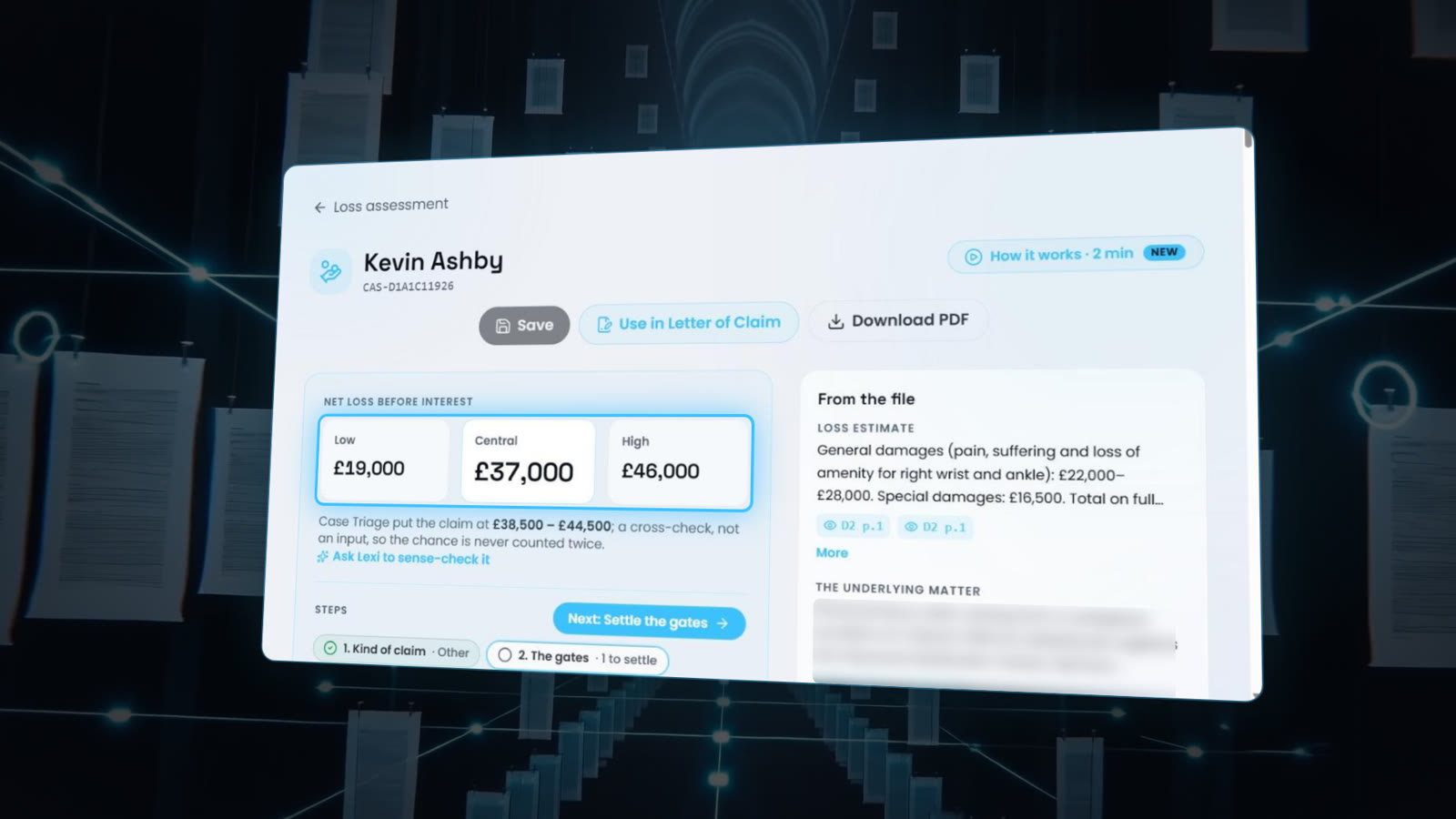
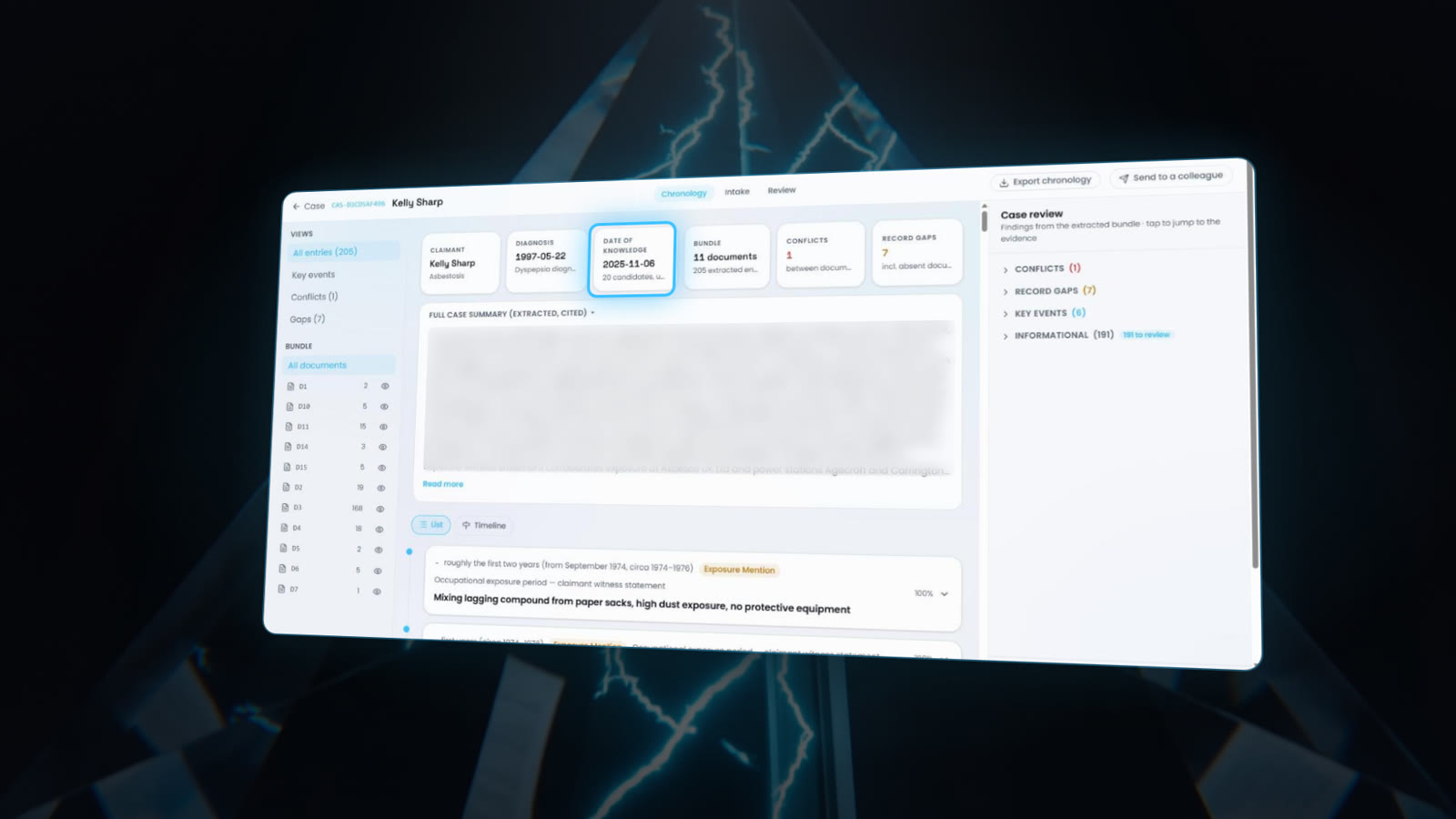
I built Plexo Legal with these duties in mind. Every chronology entry cites its source page and each quote is checked against that page; anything that cannot be verified is flagged rather than stated. Pages the system cannot read with confidence go to a person. Every output stays a draft until a fee earner approves it, and every AI action is logged, along with every correction and who made it.
On data, every account uses multi-factor sign-in, each firm's data is separated by row-level security (a database control that walls one firm's records off from every other firm's), access is role-based, and client data is never used to train AI models. A note on certification: Plexo Logic doesn't hold SOC 2 or ISO 27001 certification itself, but the providers whose infrastructure hosts Plexo Legal are independently certified to both. The full detail is on our security page.
Software can't meet a firm's regulatory duties for it. A good tool can make the safe way of working the easy one, and give the COLP a record to point to. You can see how the product fits claimant work on the Plexo Legal page, and how it handles the most sensitive files on our clinical negligence page.
What to do next
Read the SRA's warning notice in full, check your firm's AI policy against the eight rules above, and put your current tools through the supplier questions. If you are comparing specialist tools for claimant litigation, our guide to the best legal AI software for UK law firms sets out the main categories. If you'd like to see how Plexo Legal handles citations, approvals and the audit trail on a real bundle, book a live demo.
Frequently asked questions
Can solicitors use AI under SRA rules?
Yes. The SRA lets firms choose their own tools and ways of working, provided they meet its standards. The solicitor remains accountable for anything produced with AI, so the work must be competent, supervised, accurate and confidential, just as it would be without AI.
Does the SRA approve or certify AI tools for law firms?
No. The SRA regulates solicitors and firms, not software, and it does not certify AI products. Be wary of any supplier that implies otherwise. A good tool can help a firm meet its SRA duties, but responsibility always stays with the firm and its solicitors.
What is the SRA warning notice on AI?
It is guidance titled "Misuse of AI", published by the SRA on 17 August 2026. It sets out the SRA's concerns about AI-generated false citations and breaches of client confidentiality, maps them onto the existing Code of Conduct, and warns that ignoring it puts solicitors at risk of disciplinary action.
Who is responsible if AI makes a mistake in legal work?
The solicitor and the firm. The SRA says AI has no separate legal personality and that you remain accountable for your work however it was prepared. Supervisors are accountable for work done through their teams, and managers and the COLP are responsible for the firm's systems and controls.
Can I put client documents into a public AI chatbot?
The SRA's warning notice says this is likely to breach client confidentiality and may permanently waive legal professional privilege. Client information should only go into systems with proper contractual, technical and organisational safeguards, where it stays secure and is not used to train AI models.
What should a COLP do about AI?
Make AI use part of the firm's compliance framework: an approved tools list, clear data rules, a verification rule for citations and facts, human approval before anything leaves the firm, training, an audit trail and regular supplier reviews. The Code for Firms requires effective governance and supervision systems, and AI is covered by both.
The SRA wants firms to use AI where it helps and to stay in charge of it. For a claimant firm, that starts with tools that show where every point came from.
Sources and references
- 1.Misuse of AI: warning notice(Solicitors Regulation Authority, 17 August 2026)
- 2.SRA Code of Conduct for Solicitors, RELs, RFLs and RSLs(Solicitors Regulation Authority)
- 3.Risk Outlook report: the use of artificial intelligence in the legal market(Solicitors Regulation Authority, 20 November 2023)
- 4.R (Ayinde) v London Borough of Haringey [2025] EWHC 1383 (Admin)(High Court, Divisional Court, 6 June 2025)
- 5.Generative AI: the essentials(The Law Society, updated 23 November 2026)
- 6.Special category data(Information Commissioner's Office)
- 7.Artificial Intelligence (AI) Judicial Guidance (October 2025)(Courts and Tribunals Judiciary, 31 October 2025)

Diego builds Plexo Legal, AI case analysis software for UK claimant law firms. He is trained and certified in AI through Google and Anthropic. About Plexo Logic →
See a real bundle analysed, live.
Cited chronologies, case triage and limitation, run on a file while you watch.
Book a live demo