
The fix
Medical Record Intelligence
Every page read and analysed, records put in order and separated from correspondence, and a dated chronology built with every entry cited.
Word chronology and ordered records bundle
Plexo Legal is clinical negligence AI software. It reads every page of the medical records, puts them in order, builds a cited medico-legal chronology, tests breach and causation, audits consent and candour, and places the claim against what the NHS actually settles. Your team approves every output.
Pick the problem that costs your department most.
GP notes, several trusts, radiology and letters arrive out of order and partly handwritten. Someone has to sort them before anyone can judge the case.
Every page is read and analysed, the medical records are put in date order and separated from correspondence, and a dated chronology is built with every entry cited to its page.
The breach is obvious. What it actually caused, and what would have happened anyway, is not.
An adversarial review sets out what holds, where the claim is vulnerable, what the negligence actually caused and which evidence is still missing.
Which track will the claim be allocated to? Do fixed recoverable costs apply? Is work in progress quietly outrunning what it can recover?
Each case shows its likely court track and whether fixed recoverable costs apply, with a traffic-light rating of work in progress against value and the published settlement figures beside it.
A three-year limitation clock that started on a date of knowledge nobody wrote down.
Limitation and date-of-knowledge reasoning sit on every file, and a personal briefing every working morning tells each fee earner which dates and responses need them first.
Every clinical negligence case is placed against NHS Resolution settlement data, the published statistics on how many claims of that value settle, what claimant costs they carry and how long they take, by value band and by clinical specialty, across 19 years.
Source: NHS Resolution annual statistics, 2006/07 to 2024/25. Contains public sector information licensed under the Open Government Licence.
Each case shows its likely court track and whether fixed recoverable costs apply, with a traffic-light view of work in progress against what the claim can carry. Every working morning, each fee earner gets their own briefing on the dates and responses that need them first.
Every page read and analysed, records put in order and separated from correspondence, and a dated chronology built with every entry cited.
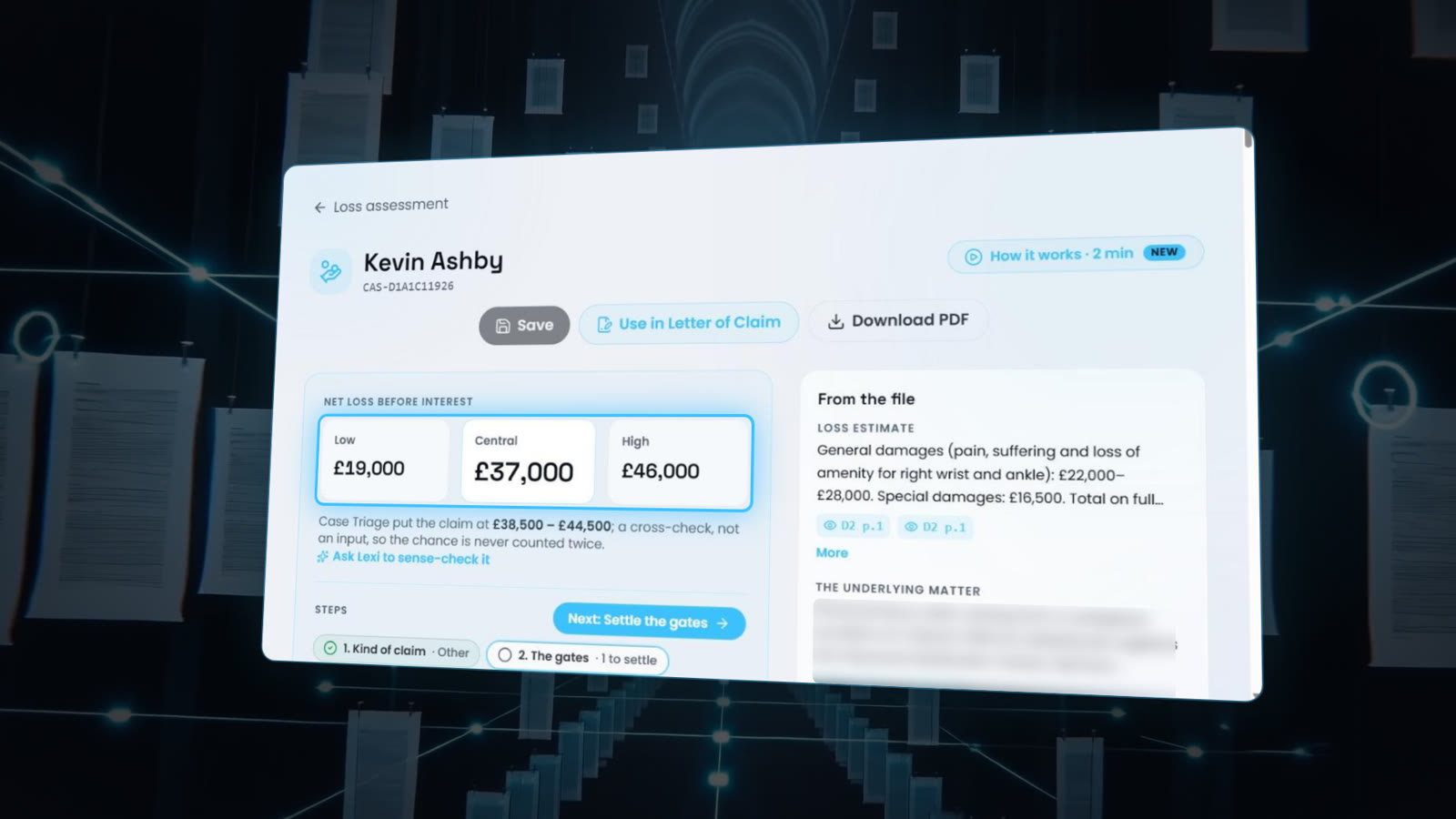
A prospects band, a recommendation and a valuation range from your firm’s own brackets, before you instruct an expert.
Argues the defence: what the negligence caused, what would have happened anyway and which evidence is missing.
Places the case against NHS Resolution’s published settlements by value band and clinical specialty, with costs against the band average.
Tests the record against informed consent and each step of the statutory duty of candour, with every gap cited.
Limitation reasoning on every file, the claim’s track and a traffic-light costs view, with a morning briefing when dates get close.
The record is tested against the modern law on informed consent and each step of the statutory duty of candour. Every gap is cited to the page, ready to put to your expert.
Every assessment is argued from the defence side: what the negligence actually caused, what would have happened anyway, and which evidence is still missing.
A reported clinical negligence judgment was rebuilt as a disguised bundle and run blind. The assessment limited the loss to the avoidable harm, exactly where the court drew the line.
Whether your nurses and clinicians work in-house or you prepare records for clinical negligence solicitors, the medical chronology software gives them an ordered, cited first draft. They check any page side by side with its scan and correct it with a full audit trail.
See how it works for each role →If yours is not here, ask us in the demo. We will show you on a real bundle.
In November 2026, a 253-page, 43-document bundle went from upload to ordered medical records, a cited chronology and an assessment in about 11 minutes. A 750-page bundle became an 856-entry cited chronology in 55 minutes. Larger bundles can also be queued to run overnight.
Yes. Scanned and handwritten pages are read as part of the bundle. Any page it cannot read with confidence is set aside for a person, who sees the scan beside the extracted text and can approve, correct or mark it unreadable.
Yes. Each case shows its likely court track and whether fixed recoverable costs apply, with a red, amber, green view of work in progress against what the claim can recover.
No. It gets the records into order, tests breach and causation and shows where the evidence is thin, so you instruct the right expert with a better brief. The expert opinion stays with the expert.
No. The valuation range comes from your firm’s own quantum brackets. NHS Resolution’s published figures sit beside it as context and are deliberately kept separate.
Every chronology entry cites its source page, and each quote is checked against that page. Anything that cannot be verified is flagged rather than stated, every correction is logged with who made it and when, and nothing is final until a fee earner approves it.
Your case management system stays the official record. You export the bundle, Plexo Legal does the reading and analysis, and you save the results back to the matter like any other document.
Thirty minutes, then compare what Plexo Legal found with what actually happened.