How is AI used in NIHL and asbestos claims?
AI reads the whole industrial disease file and turns it into a cited exposure history, a list of possible dates of knowledge, a check on every employer and an early view on prospects. Here is where it helps on NIHL and asbestos claims, and where the judgement stays with the lawyer.

In noise-induced hearing loss (NIHL) and asbestos claims, AI is used to read the whole file and turn it into the four things a fee earner needs first: a cited exposure history employer by employer, a list of possible dates of knowledge, a check on whether each defendant employer still exists, and an early view on prospects and costs. Used well, it tells a claimant firm which disease files are worth the work before the expensive steps begin, and stops limitation dates and dissolved defendants catching anyone out.
I founded Plexo Logic, and we built Plexo Legal for exactly this kind of file. This guide explains where AI genuinely helps on industrial disease claims, where the judgement stays with the lawyer, and how Plexo Legal handles an NIHL or asbestos file.
Why industrial disease files are hard to run profitably
Disease claims look simple from the outside and rarely are. A claimant may have forty years of working life, half a dozen employers and a witness statement written from memory. The exposure often dates back decades: the Health and Safety Executive attributes many mesothelioma deaths to past occupational exposure from the widespread industrial use of asbestos between 1950 and 1980. Some of those employers were dissolved long ago.
The numbers remain significant. HSE recorded 2,146 mesothelioma deaths in Great Britain in 2024, down from 2,255 in 2023, and it estimates that around 16,000 workers had work-related hearing problems over 2023/24 to 2025/26.
Meanwhile the fee is often fixed. Part 45 of the Civil Procedure Rules sets fixed recoverable costs for NIHL claims on the fast track in a section of its own (Section VIII), and claims on the intermediate track carry their own fixed costs (Section VII, Table 14). When the fee is fixed and the time is not, the margin on each file depends on how quickly the facts can be established and how early a weak file can be closed.
Where AI helps on an NIHL or asbestos file
A cited exposure history, employer by employer
The medical records, occupational health notes, the HMRC employment schedule and the witness evidence are read together. Each employer, each period of exposure and any hearing or respiratory protection is drawn out and cited to its page. Where the claimant's memory and a contemporaneous record disagree, the record is weighed above the recollection and the conflict is flagged.
Breach judged by the standards of the time
An employer's duty is judged by what it should have known and done at the time, not by today's standards. Good software sets each period of exposure against the regulations and guidance in force then, so the fee earner can see at a glance which employers and which years carry the claim.
Date of knowledge and limitation
Personal injury claims must usually be brought within three years of the injury, or of the claimant's date of knowledge if that is later (Limitation Act 1980, section 11). In disease claims the date of knowledge is where files are won and lost: a GP entry from years ago that says "hard of hearing" might have started the clock. Under section 14, the date of knowledge turns on when the claimant knew the injury was significant, that it was attributable to the employer's acts or omissions, and who the defendant was.
AI can find every candidate date in the record, cite each one to its page and flag the earliest arguable date, and note where the court's discretion under section 33 may be needed. Deciding which date is right remains the lawyer's call.
Employers that no longer exist
A strong claim against a dissolved company changes the route to recovery: the claim may run against the insurer on risk for the period, or the company may need to be restored to the register. Checking every defendant against the live Companies House register at the start, and recording the insurer position for each exposure period, turns that from a late surprise into a planned next step.
Prospects and costs before the expensive work
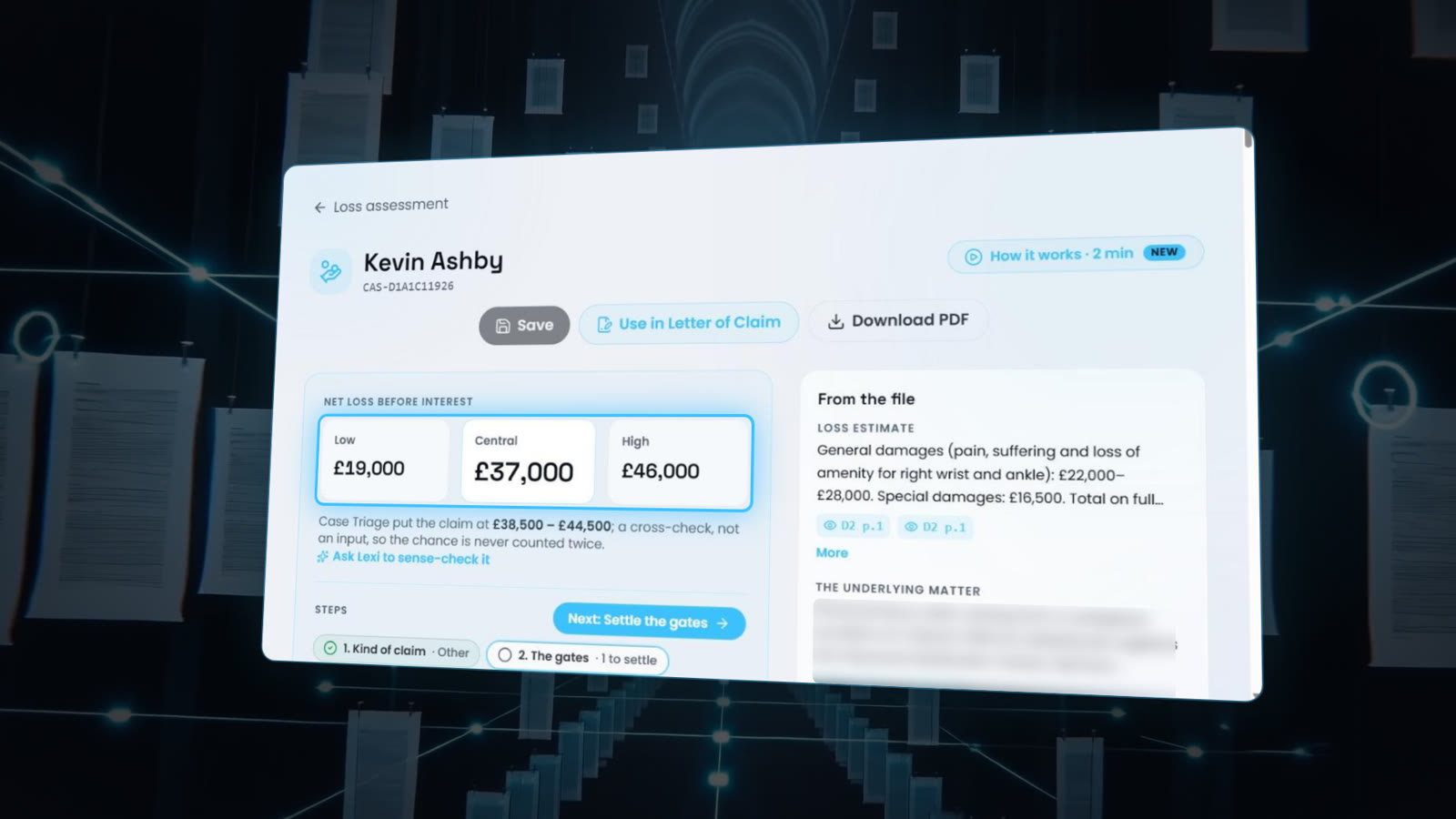
The most valuable output on a disease caseload is an early, reasoned view of which files to pursue. That means a prospects band, a recommendation and a valuation range for each file before the expert is instructed, alongside the likely track, the fixed costs position and a traffic-light view of work in progress against value.
What it looks like on a file
On a fictional asbestos demo file of 11 documents, Plexo Legal built a chronology of 205 cited entries and found 20 possible dates of knowledge in the record, each cited to its page. It weighed the exposure evidence for each employer separately, judged breach against the regulations of the era, and returned a Proceed outcome with moderate prospects and every reason cited. It also flagged that the main defendant had been dissolved and set out the recovery route.
Across a caseload, the same results let you sort every disease file by chance of success, value or limitation date, so the files that need attention this week rise to the top.
Where the judgement stays with the lawyer
AI does the reading and the cross-referencing. It does not replace the medical expert, the engineer or the fee earner's judgement on causation and apportionment. In Plexo Legal every output stays a draft until a lawyer approves it, every fact links to its page, and anything that cannot be verified against the record is flagged rather than stated as fact.
How Plexo Legal handles industrial disease claims
Plexo Legal brings these steps together for NIHL and asbestos files:
- Medical Record Intelligence: every page read, including old scans and handwriting, with a dated chronology cited to the page.
- Case Triage for NIHL and asbestos: a prospects band, a recommendation and a value range from your firm's own brackets, with exposure, breach by era, causation and limitation tested.
- Party and Insurer Intelligence: each defendant employer checked against the live Companies House register, with the insurer position recorded for each exposure period.
- Key Dates and Limitation: the limitation clock on every file, with the date of knowledge reasoning and warnings well before anything expires.
- Track and Costs: the likely track, the fixed recoverable costs position and a traffic-light view of work in progress against value.
- Drafting and Letters: the Disease and Illness protocol letter of claim, occupational records requests and HMRC employment history requests, drafted from the cited record and approved before they go.
Each tool has a short walkthrough film on our industrial disease page. If the medical records are your bottleneck, our guide to medical chronology software goes deeper.
Frequently asked questions
Can AI work out the date of knowledge in a disease claim?
It can find every candidate date in the record, cite each one to its page and flag the earliest arguable date. Choosing the date to rely on, and whether to ask the court to exercise its discretion under section 33 of the Limitation Act 1980, remains a decision for the lawyer.
What happens if the employer has been dissolved?
The claim may proceed against the insurer that was on risk during the exposure period, or the company may need to be restored to the register. Plexo Legal flags a dissolved defendant as soon as the register is checked and records the insurer position for each period. Tracing the insurer itself, for example through the Employers' Liability Tracing Office, remains a step for the fee earner.
Do fixed recoverable costs apply to NIHL claims?
For many claims, yes. Part 45 of the Civil Procedure Rules has a section dedicated to NIHL claims on the fast track, and the intermediate track has its own fixed costs. Which regime applies depends on the track the claim is allocated to, so check the current rules for each file.
Is AI accurate enough for industrial disease work?
Only if you can check it. In Plexo Legal every fact links back to the page it came from, unverified points are flagged rather than stated as fact, and nothing is relied on until a lawyer approves it.
Industrial disease work rewards the firms that know early which files to back. AI that reads the whole file, cites every fact and checks every employer gives you that view while the claim is still cheap to decide. To see it on an NIHL or asbestos file, book a live demo.
Sources and references
- 1.Mesothelioma statistics for Great Britain, 2026(Health and Safety Executive, November 2026)
- 2.Noise induced hearing loss in Great Britain(Health and Safety Executive, updated 29 October 2026)
- 3.Civil Procedure Rules, Part 45: Fixed costs(Ministry of Justice)
- 4.Limitation Act 1980, section 11(legislation.gov.uk)
- 5.Limitation Act 1980, section 14(legislation.gov.uk)
- 6.Limitation Act 1980, section 33(legislation.gov.uk)

Diego builds Plexo Legal, AI case analysis software for UK claimant law firms. He is trained and certified in AI through Google and Anthropic. About Plexo Logic →
See a real bundle analysed, live.
Cited chronologies, case triage and limitation, run on a file while you watch.
Book a live demo