Medical Record Intelligence
Reads and analyses every page, puts the records in order, separates them from correspondence and builds a dated chronology with every entry cited.
Plexo Legal is legal AI software from Plexo Logic, a UK legal AI company. It reads and analyses every page of the bundle, puts the medical records in order and builds a cited chronology, then assesses prospects and value and argues the case against you. A fee earner approves every output.
Using Proclaim? See exactly where Plexo Legal fits →Open any page beside the text extracted from it. Approve it, correct it or mark it unreadable. The original reading is never deleted, and every correction is saved with who made it and when.
Each tool starts with a problem you will recognise, and each has a short walkthrough showing how it is solved on a real case file.
Reads and analyses every page, puts the records in order, separates them from correspondence and builds a dated chronology with every entry cited.
A prospects band, a recommendation to proceed, investigate or decline, and a valuation range from your own brackets, before you commit.
An adversarial review of every assessment: what holds, where it is vulnerable, what evidence is missing and how the defence will run.
Places each case against NHS Resolution’s published settlements by value band and clinical specialty, with your costs set against the band average.
Tests the record against informed consent and the statutory duty of candour, step by step, with every gap cited to its page.
Sorts the professional’s file into what they were instructed to do, advised, warned of and how the retainer ended, with scope checks run against it.
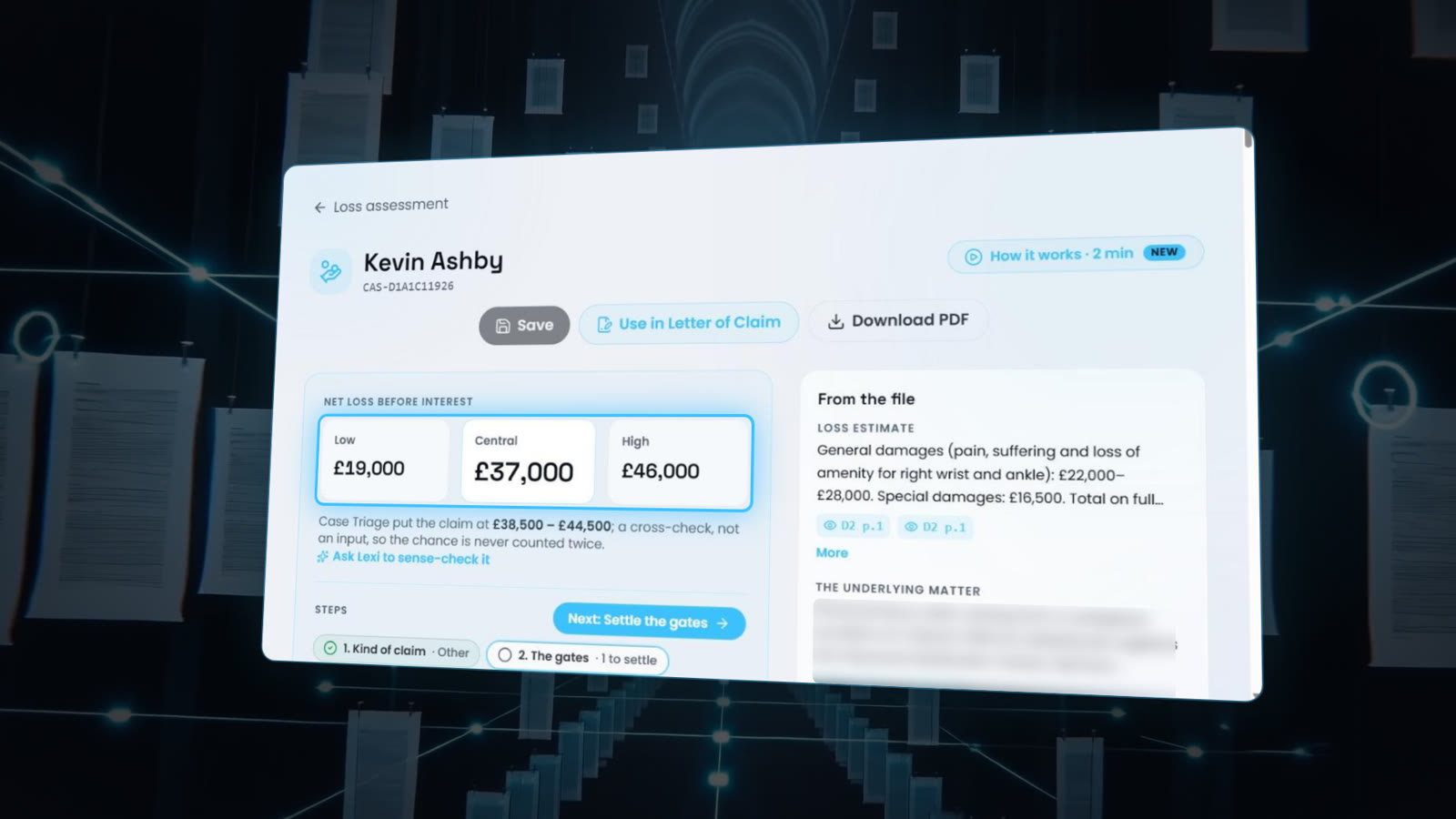
Builds the schedule in order: what the client would have had, less what they have, through loss of chance, costs, the scope cap, credits and contributory negligence.
Limitation clocks on every file and a daily email flagging dates inside 90 days and overdue responses, plus each case’s track and a traffic-light view of costs against value.
Drafts written from the evidence in your own templates, approved before they go, then chased until someone replies.
Most medical chronology software stops at the chronology. Plexo Legal reads and analyses every page, puts the records in order, builds the cited chronology and then assesses the case. These are the measured times.
Every page read and analysed, records ordered, a cited chronology built, gaps and conflicts flagged and the triage outcome ready for a fee earner.
A 750-page bundle turned into 856 dated chronology entries, each one cited to its source page, with no fee-earner time while it ran.
A reported judgment rebuilt as a disguised bundle and run blind. The assessment limited the loss to the avoidable harm, as the court did.
“A recent bundle took two of our team six days. Plexo Legal processed the same files in under an hour.”
Measured on production runs, November 2026, mostly scanned PDFs. Word documents and emails skip the scanning step, so they move faster still.
Plexo Legal works alongside each person as a production multiplier. Pick the one that sounds like you and see what it takes off your desk, and what stays yours.
No partner has time to read two hundred open files, yet the risk on every one of them sits with you.
Two hundred open files across the department, and a new batch of enquiries every week.
Half the week goes on reading the file, not advising on it.
A new 300-page bundle lands on a case you are running, with a client call booked for Friday.
Every enquiry needs a decision, and the paperwork arrives in pieces.
Ten new enquiries on a Monday morning, each with a statement and a handful of records.
A 1,000-page bundle used to mean days of sorting before any clinical review could start.
A 1,000-page bundle of GP notes, hospital records, radiology and letters arrives for a chronology.
Before the day starts, everyone gets their own email: the decisions waiting on them, their deadlines this week, what changed on their files overnight and messages from their team. It is a task list and a file update in one, every Monday to Friday.
It names cases by reference only, never by client, so nothing sensitive sits in an inbox.
Proclaim, or whichever case management system you use, stays your system of record. Plexo Legal is where the file gets read and analysed. For now, documents move across by export and upload, and the results go back onto the file like any other document. However, we are working on making that hand-over smoother, so less of it needs doing by hand.
Download the bundle from the matter as you would for counsel, then drag it into a new Plexo Legal case. Proclaim’s own exports can go in too, and the Proclaim matter reference is kept on the case so the two stay matched.
Records put in order, the cited chronology, triage, the case against, limitation, costs and draft letters. Your team reviews and approves it here, with Lexi on hand for questions.
Download the Word chronology, the triage report, the ordered medical records bundle or an approved letter, and save it to the matter like any other document. Proclaim keeps the official record.
Matters, tasks, time recording, billing, correspondence, workflows and your official file. Nothing about it changes.
The work Proclaim was never built to do: reading every page, ordering the records, assessing the case and drafting from the evidence.
Plexo Legal is independent and is not affiliated with or endorsed by the makers of Proclaim.
Every area has its own reference packs, tools and page. Shared tools work across all of them.
Asbestos-related disease and noise-induced hearing loss, from exposure history to limitation and date of knowledge.
Medical chronologies, breach and causation, consent and candour, and every case placed against published NHS settlement data.
Claims against solicitors and other professionals: what the retainer covered, what went wrong and what the client actually lost.
Lexi has read the whole file. She answers by voice or text with citations, spots what is missing before the other side does, and takes you to the exact place on screen.
Reads only the cases you are allowed to see, inside your firm’s walled-off data.
Cites every point. If the file does not say it, neither does she.
Navigates to the right case and tool and highlights what she means, so new staff barely need training.
Proposes, never decides. Anything she suggests waits for a fee earner.
Pt seen 00:42. Fall onto outstretched R hand. Tender distal radius. X-ray R wrist reviewed: no obvious fracture seen.
Plan: discharge with soft-tissue advice. Fracture clinic review in 7 days if pain persists.
Safety-netting advice given. GP letter sent.
No. The discharge plan says fracture clinic review in 7 days if pain persists, but there is no referral, attendance or missed-appointment entry anywhere in the bundle. I have flagged it as a record gap.
Breach looks strong: the addendum report says the fracture was visible on the first film, and the Trust admits it. Causation is narrower: the loss is the avoidable operation and its after-effects, not the fracture itself.
Opening Key Dates and Limitation now. The primary limitation date is highlighted, with the date-of-knowledge reasoning underneath it.
Reported cases show only the claims that went to trial. Plexo Legal places each clinical negligence case against NHS Resolution’s published settlements: by value band, by clinical specialty and across 19 years, with your work in progress set against the band’s average claimant costs. Context, never calculation: it stays separate from your valuation.
Source: NHS Resolution annual statistics, 2006/07 to 2024/25. Contains public sector information licensed under the Open Government Licence.
“I cannot recommend Plexo Logic enough. They have changed our business immeasurably. Excellent service.”
The questions your DPO will ask, answered before they ask them.
Read the security overview →Thirty minutes. A case is created and run while you watch, then we tour the result with Lexi.

You will speak to the person who built it, not a sales team.