How do you make a LinkedIn carousel with Claude and Higgsfield in ten minutes?

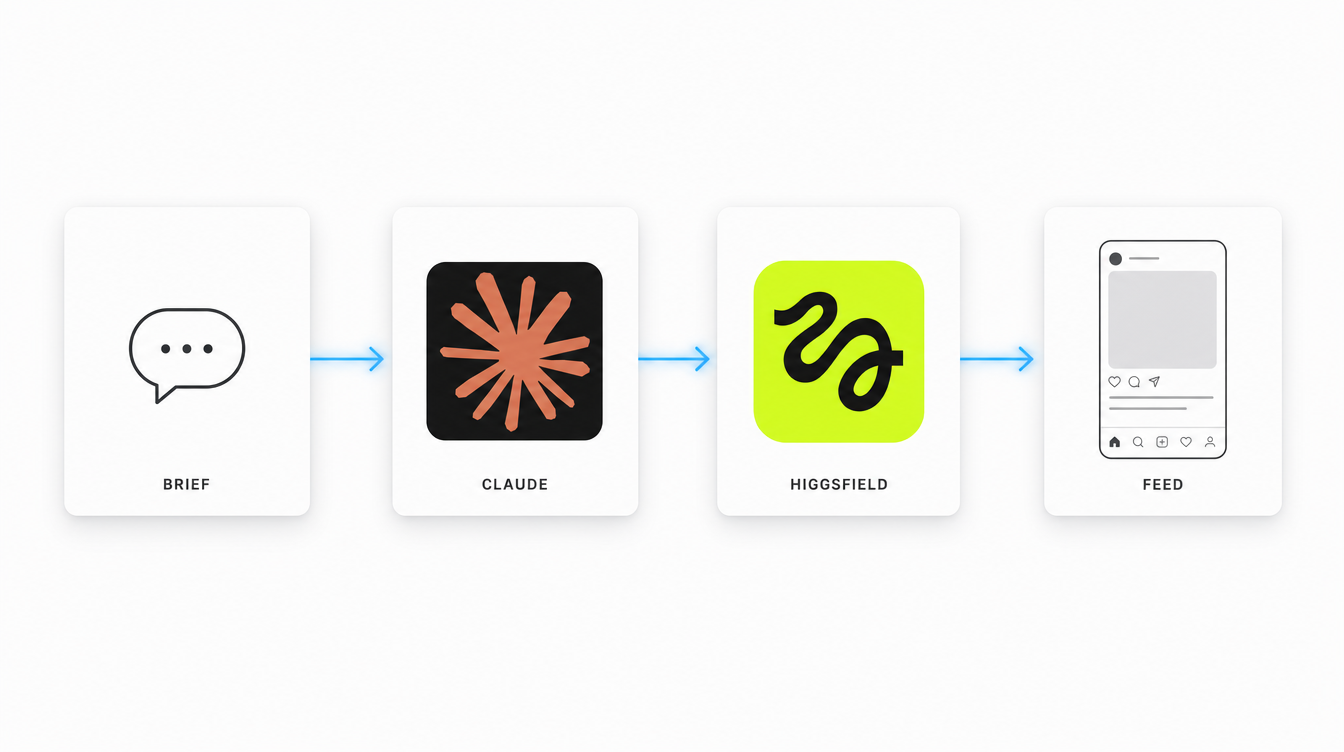
I built the four-slide LinkedIn carousel attached to this article in about ten minutes. Brief in plain English, four polished images out the other side, assembled into a PDF and ready to post. That sentence would have been a fantasy six months ago. This week it became operationally normal, because Higgsfield shipped a direct integration with Claude through MCP, and the production maths for social media changed quietly underneath us.
This is the article I wish had existed when I first heard about it, because the implication for any agency, marketing team, or solo founder who ships content is bigger than "another AI tool launched". It is a structural shift in what production work even means.
Download the carousel: plexo-logic-higgsfield-claude-carousel.pdf. Four square slides, ready to upload to LinkedIn as a Document post.
The ten-minute carousel that broke the spreadsheet
Six months ago, making a four-slide LinkedIn carousel meant this routine. Open a brief. Write a prompt in Claude or ChatGPT to refine the angle. Copy the prompt into an image generation tool. Generate. Download. Open Photoshop or Canva. Resize, lay out, add the headline overlay, fix the typography. Repeat for slide two, three, four. Combine them into a PDF or upload as a multi-image post. Half a day of tab-switching, even when the tools mostly behaved.
Today the conversation went like this. I told Claude I wanted a four-slide carousel announcing a new feature. We agreed the angle, the headline anchor and the tone in two short messages. Claude wrote the prompts. Claude called Higgsfield directly through MCP, asked it to use GPT Image 2 (arguably best in class for infographics right now), and four square 1024x1024 PNGs came back into the conversation a couple of minutes later. We swapped one slide for a tighter version, fed Claude the official brand logos so the icons rendered correctly, then assembled the four images into a print-ready PDF. Total time, roughly ten minutes, most of which was thinking time.
The thing that changed is not "AI is better at images", though it is. The thing that changed is that the agent doing the writing can now reach the agent doing the drawing, without a human sitting in the middle copying and pasting. That sounds incremental. It is not. It collapses the entire production pipeline into a single conversation.
The production bottleneck used to be the tools. The production bottleneck is now the brief.
What actually changed at the technical layer
Higgsfield, the multi-model image and video generation platform, exposed an MCP server that any Claude account can connect to in under five minutes. Settings, Connectors, Add Custom Connector, server URL, sign in with the Higgsfield account. Done. From that point, Claude can call Higgsfield's full model library directly: GPT Image 2 from OpenAI, Nano Banana Pro from Google, Flux from Black Forest Labs, Soul for character consistency, Kling and Veo and Seedance for video. No API keys to manage. No separate subscription. The Higgsfield credits already on your plan are what gets spent.
MCP, Anthropic's Model Context Protocol, made this possible by giving every Claude conversation a clean, standardised way to call external tools. Higgsfield was an early adopter, and the result is the first practical multi-modal pipeline that does not require a developer to assemble. A marketing director who can write a clear brief can now run the whole flow themselves.
For anyone keeping score, this is also the moment the line between "chat tool" and "production tool" stops being meaningful. Claude is the production tool. Higgsfield is the production tool. They are the same conversation.
Why model selection just became a real skill
The cliche about AI is that it democratises creativity. Half-true. What it actually does is shift the skill set from "can you use the tool" to "do you know which tool to point at which problem". With twenty-plus image and video models reachable inside one conversation, the consultant who knows that GPT Image 2 handles legible typography better than Nano Banana 2, that Soul is the right pick for character continuity across a campaign, that Veo is built for cinematic product shots and Seedance for character-driven motion, has a real edge. The consultant who treats it all as "use AI" produces forgettable slop.
This is the bit nobody on LinkedIn is selling courses for yet, because it is not photogenic. It is just experience, taste, and reading the model release notes every week. But it is the difference between a carousel that converts and one that gets ignored.
The skill is no longer prompting. The skill is choosing the right model for the job, and prompting it well.
What this means for agencies and marketing teams
Three things shift when production collapses to ten minutes.
First, the cost basis of "we'll do your social content" agencies stops working. If a competitor can produce comparable output in a tenth of the time, the agency charging for hours of mechanical execution is in trouble. The agencies that priced on strategic thinking, brand judgment, and creative direction quietly become much more attractive.
Second, in-house teams of one or two get the leverage of a team of ten. A solo marketing manager at a fifty-person SME can now run a social calendar that looked impossible without a junior, a designer, and a strategist between them. Whether they realise it or not, this is happening to their competitors right now.
Third, the bottleneck genuinely moves to the brief. The cleaner the brief, the better the output. The looser the brief, the more the AI freelances and the more time is spent fixing things. The single highest-leverage skill in 2026 marketing is writing a brief that an AI can act on without making things up.
The traps no one is talking about yet
Speed is the gift. Discipline is the cost. A few honest observations from running the workflow for real.
Brand consistency is still the operator's job. AI does not know your hex codes, your typography, your tone of voice, or which competitor's icon it must absolutely never accidentally render on your slide. We had one slide come back with the Gemini logo where Claude's mark should have been, because the prompt used the word "spark" and the model defaulted to its most familiar referent. Fixed in one regen by feeding it the actual brand logo as a reference image, but it would have been an embarrassing post if it had gone live unchecked.
Brand impersonation is a related risk. Image models will happily produce something that looks suspiciously close to a competitor's product shot, a real person's face, or a recognisable platform's UI. The legal and reputational exposure of that landing in a paid campaign is non-trivial. Speed is not a defence.
The third trap is the most subtle. The thing that used to take hours, the layout work in Canva or Figma, was also an enforced pause that gave the operator time to reconsider whether the message was right. With ten-minute production, that pause vanishes. Mediocre ideas now ship at full speed alongside the good ones. The post-launch self-edit becomes more important, not less.
The pipeline got faster. The judgment did not. Build that gap into your process or it will eat you.
So what should you actually do this week?
If you ship social content in any form, do this. Connect Higgsfield to your Claude account, which takes under five minutes. Pick one production task you would normally hand to a designer or do over a half-day yourself. Run it end to end through the new pipeline. Time it. Then have an honest conversation with yourself, your team, or your retained agency, about where those saved hours should now go.
The teams who treat this as a cost-cutting exercise will save a few quid and stay where they are. The teams who treat it as a quality-raising exercise, taking the time saved and pouring it back into better thinking, sharper briefs and more deliberate brand work, will look like geniuses by Christmas.
If you want a structured walkthrough on your own setup, book a 15 to 30 minute call. No deck, no pitch. Just a clear look at where the new pipeline could fit your team, and what to watch out for as you wire it in.