AI in legal firms: the 6 to 12 month window that will decide which European practices win


Download the free 12 page playbook that accompanies this article. It contains the architecture decision matrix, EU AI Act milestone checklist, platform comparison, sixty minute self assessment and ninety day pilot blueprint.
A 26 year old Swedish founder just turned the legal AI conversation into something European law firms cannot keep ignoring.
Max Junestrand is the co-founder of Legora, a Stockholm based legal AI platform. In a 20VC interview with Harry Stebbings published in March 2026, he explained how the company tripled its valuation in five months. Legora has closed a 550 million dollar Series D led by Accel, taken a follow on extension from Nvidia, Atlassian, Barclays and others, and is now valued at roughly 5.55 billion dollars. It serves around 750 of the world's leading law firms.
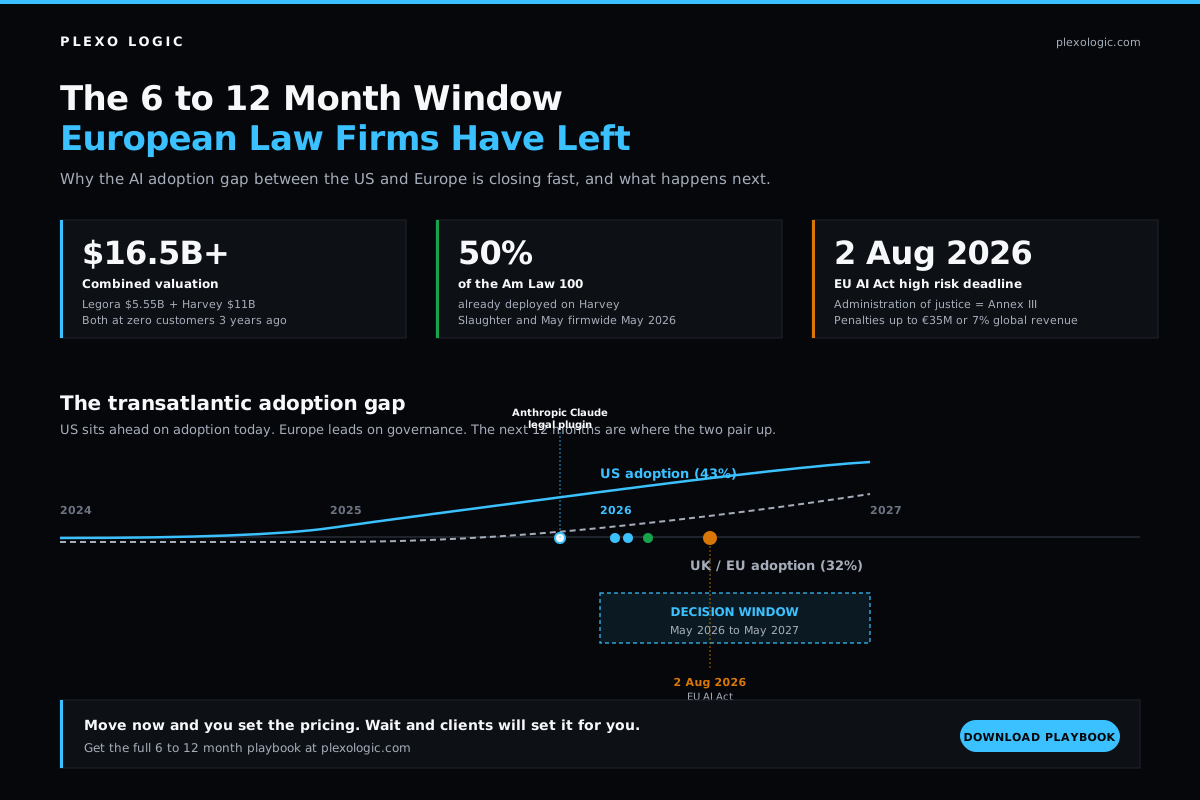
Harvey, the US challenger, raised 200 million dollars in March 2026 at an 11 billion dollar valuation. 100,000 lawyers, 1,300 organisations, half of the Am Law 100. Slaughter and May rolled it out firmwide in May. Torys did the same in April.
Two AI native legal platforms, combined valuation north of 16 billion dollars, deployed across the highest grossing law firms in the US and the City. This is the new operating layer for legal work.
I have been building practical AI tooling for the legal industry for almost a year. Twelve months ago partners asked whether AI was a real thing. Today they ask which platform their competitors are using and how to catch up without breaking client confidentiality.
The adoption gap, honestly assessed
Brookings and the St Louis Fed put 2026 AI adoption at roughly 43 percent of US workers versus a 32 percent European average. The UK leads Europe at 36 percent. The legal sector tracks the same shape, with the US ahead on adoption and revenue.
That gap is real. It is not, however, a fixed timer. Europe leads on several things. GDPR forced privacy engineering disciplines into European stacks years before US firms had to think about them. The EU AI Act is producing audit and governance practice that US firms will eventually need to copy. Several Magic Circle firms are running deployments today that match or exceed their Am Law 100 counterparts.
The honest read is that the US has more capital concentrated on legal AI right now, which means faster vendor maturity and faster product cycles. Europe has stronger compliance scaffolding, which means slower starts but more defensible deployments. The next six to twelve months are when European firms can pair the EU regulatory advantage with US grade tooling, before procurement teams at FTSE 100 and DAX 40 buyers start asking which platform you are on as a default question.
Legal needs a human touch. AI is the leverage around it.
The obvious caveat. Legal work is one of the few industries where the human moment is not optional and never will be. Client counsel, courtroom advocacy, judgment calls under uncertainty, partner level negotiation, those stay human. Anyone selling AI that promises to replace those moments is either misunderstanding the work or hoping you do.
What AI changes is everything around the human moment. Intake and conflicts, document discovery, due diligence at scale, contract clause analysis against a configured firm playbook, NDA triage, regulatory research, bundle preparation, templated drafting, billing narratives, knowledge management. All leverage work that today eats associate hours and partner review time.
AI is not replacing your lawyers. It is giving them back the hours they currently spend on the work that drains them, so they can spend those hours on the parts of practice that built their reputation in the first place.
What is actually changing
Anthropic released the Claude legal plugin in February 2026. Contract review, NDA triage, vendor checks, compliance briefings and signature routing as configurable skills layered on top of Claude. Thomson Reuters and RELX share prices fell on the announcement. LexisNexis publicly embraced it within weeks. Foundation model providers, specialised platforms, and incumbent legal information vendors are now competing on overlapping ground. Choice of architecture matters more than ever.
The data problem has real solutions
Client confidentiality and attorney privilege are absolute. The EU AI Act adds a regulatory layer. From 2 August 2026, AI systems used in administration of justice fall into Annex III high risk. Risk management, human oversight, logging, CE marking, conformity assessment, all required. Penalties reach 35 million euros or 7 percent of global revenue.
The architectural answer is settled. Three patterns dominate.
On premise. Model and inference inside the firm's own data centre or private cloud. No client data leaves. Gold standard for criminal defence, national security, sensitive M&A.
Virtual private cloud. Dedicated tenant inside AWS, Azure or GCP with firm controlled data residency, encryption, key management and audit logging. Suitable for the majority of corporate work.
Vendor hosted with enterprise terms. Cloud hosted Legora, Harvey or Claude under contracts that prohibit training on client data and guarantee data residency. Suitable for low sensitivity drafting and research.
Most firms run a hybrid. The conversation with clients every week is not "should we use AI". It is "which work goes where, who owns the policy, and how do we prove the controls".
What clients will start asking, and when
By Q4 2026 the question shifts from "do you use AI" to "which platforms have you adopted, what is your data residency, how do you handle attorney privilege when matters touch generative AI". Procurement teams are already drafting these questions into RFPs. Firms that answer crisply win mandates. Firms that cannot lose them quietly.
The six to twelve month plan
Classify the work into three sensitivity tiers. Decide which model architecture each tier requires. This is the single most important decision you will make.
Choose a platform stack. For most UK and EU firms that means at least one specialised legal AI platform such as Legora or Harvey, plus a foundation model legal layer such as Anthropic's Claude legal plugin, plus an on premise option for sensitive work.
Run a pilot with measurable outcomes. Pick two or three workflows. Instrument them. Measure hours saved, error rates, partner review time and client satisfaction. Sixty to ninety days.
Build the policy and audit posture before you scale. Article 8 to 15 obligations, ABA model rule equivalents, GDPR records, and a published AI use policy all in place before firmwide rollout.
Train the firm. Associates and paralegals adopt fastest. Partners adopt slower. Plan for both.
Get the playbook
At Plexo Logic we run AI readiness assessments, ninety day pilot orchestration, and on premise deployments for the most sensitive work. We have built a free downloadable playbook, The 6 to 12 Month AI Readiness Playbook for European Legal Firms, that walks through every step including the architecture decision matrix, EU AI Act milestone checklist, platform comparison framework and a one hour self assessment your firm can run before any vendor conversation.
Download: The 6 to 12 Month AI Readiness Playbook for European Legal Firms (PDF)
If you want to talk through where your firm sits on the curve, book a 30 minute readiness call or email hello@plexologic.com.
The firms that move now will define the next decade of legal services in Europe. The firms that wait will spend that decade catching up.
Frequently asked questions
How quickly are European law firms adopting AI compared to US firms? US adoption is meaningfully ahead today, around 11 percentage points across the workforce, driven by capital concentration and faster firm decision making. The gap is closing as European firms move from pilots to firmwide rollouts in 2026.
What is the EU AI Act deadline? 2 August 2026 for most Annex III high risk obligations including AI systems used in administration of justice. Some obligations may shift to December 2027 under the Digital Omnibus, but plan for August.
Should a law firm run AI on premise or in the cloud? A hybrid. On premise for the most sensitive matters. VPC for the bulk of corporate work. Vendor hosted under enterprise terms for low sensitivity drafting.
What does this mean for the billable hour? Compression. Workflows that took associate days now take hours. Firms that adapt their pricing capture the margin. Firms that do not will see clients renegotiate.
Sources & References
- 1.Legal AI startup Legora hits $5.6B valuation and its battle with Harvey just got hotter(TechCrunch, April 2026)
- 2.Legal AI startup Harvey valued at $11 billion in funding round(CNBC, March 2026)
- 3.Slaughter and May rolls out AI tool Harvey firmwide(Legal Cheek, May 2026)
- 4.Anthropic moves into legal tech(Artificial Lawyer, February 2026)
- 5.The EU AI Act, six steps to take before 2 August 2026(Orrick, November 2025)
- 6.Mind the gap: AI adoption in Europe and the US(Brookings, 2026)
- 7.Why does AI adoption differ so much across countries?(Federal Reserve Bank of St Louis, April 2026)
- 8.Wolters Kluwer 2026 Future Ready Lawyer Report(Wolters Kluwer, 2026)
- 9.He built a $5.5B legal AI company by 26: Max Junestrand on 20VC(20VC with Harry Stebbings, March 2026)