How Do I Automate My Business With AI? A Practical Framework for UK SMEs

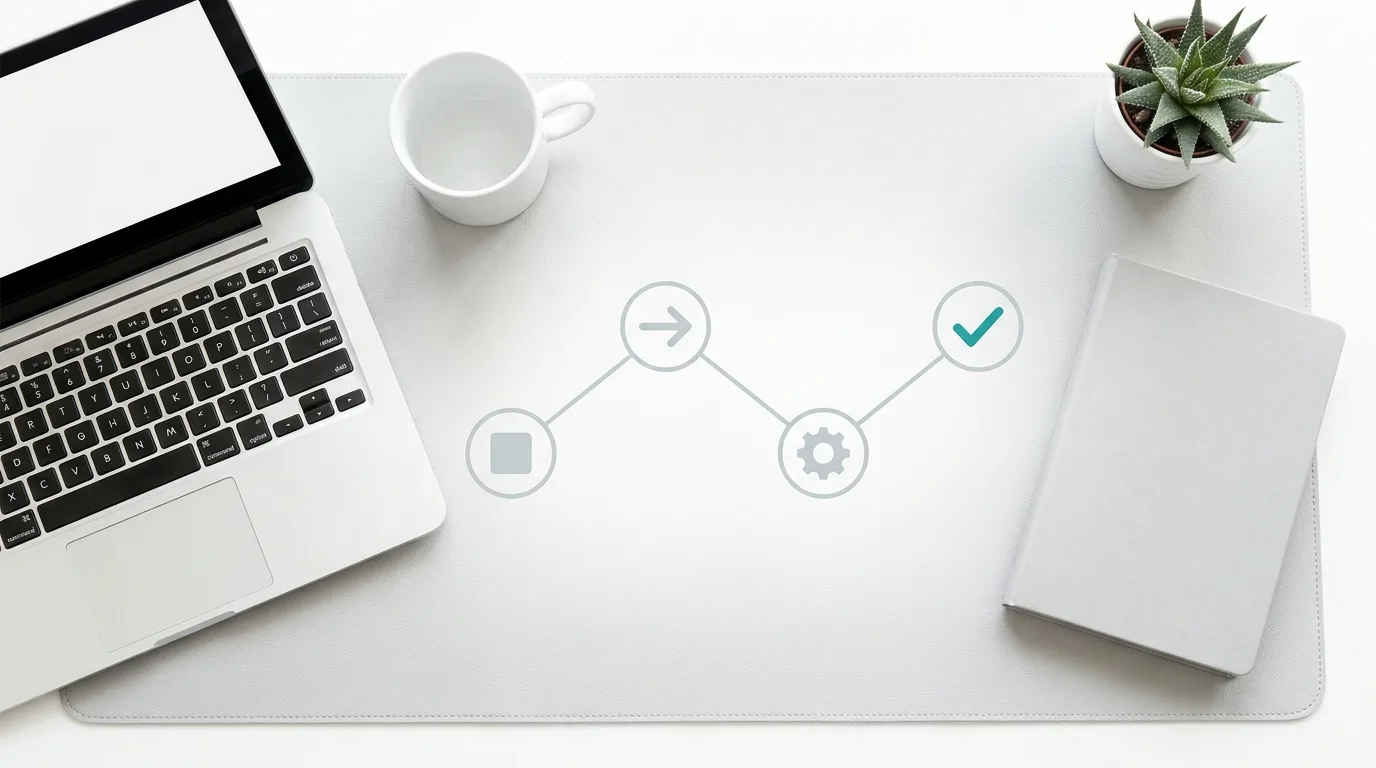
To automate your business with AI, start by finding one repetitive, rules-based task that eats hours every week, map its steps, pick a tool to run it, and measure the time it saves before you scale to the next one. The mistake most businesses make is trying to automate everything at once, or buying a platform before they know the problem. This simple four-step framework keeps it grounded, and it is the same approach that separates the AI projects that work from the ones that quietly fail.
Most owners I speak to are not short of ideas for AI. They are short of a place to start that will not turn into a six-month project with nothing to show for it. The good news is that automating your business with AI does not require a big budget or a data science team. It requires discipline about where you point it.
That discipline has a shape. I call it Find, Map, Build, Measure. It is deliberately boring, because boring is what works. Below I walk through each step, then explain why so many AI projects fail and how this approach sidesteps the trap.
The framework: Find, Map, Build, Measure
The whole framework is four steps, run in order, on one process at a time.
- Find the right first task to automate.
- Map the exact steps that task takes today.
- Build the automation on a tool that fits.
- Measure the time and money it saves before you move on.
Then you repeat it for the next process. The power is in the sequence and the restraint, not in doing anything clever. Let us take each step in turn.
Step 1: Find the right first task
The right first task is repetitive, rules-based, frequent, and currently done by a person who would rather be doing something else. Look for work that happens the same way every time and follows logic you could write down.
Good candidates: copying data between systems, sending the same follow-up emails, chasing invoices, sorting inbound enquiries, generating routine reports, formatting documents. Poor candidates: anything that needs real judgment, empathy or a relationship, and anything that only happens twice a year.
A quick test I use with clients: pick the task that, if it vanished tomorrow, would make someone on the team visibly relieved. That is usually the one worth automating first, because you will have an ally who wants it to work.
Resist the urge to pick the flashiest task. Pick the one with the clearest payback. Momentum from one working automation buys you the credibility to do the next five.
Step 2: Map how the task works today
Before you automate anything, write down exactly how the task is done now, step by step, including the messy bits. Where does the data come from? What decisions get made? What are the exceptions, and how often do they happen?
This step is where most projects are quietly won or lost. Automation only works when the process is understood. If a task has fifteen hidden exceptions that a human handles on instinct, you need to know that before you build, not after.
Mapping also tells you whether the task is ready. Sometimes the answer is that the process is too chaotic to automate yet, and the real first job is to tidy the process. That is a useful finding, not a failure.
Keep the map simple. A numbered list or a rough flowchart on one page is plenty. You are not writing a specification, you are making the invisible visible.
Step 3: Build on a tool that fits
Now, and only now, pick a tool. The task defines the tool, never the other way round. Buying a platform before you understand the problem is the single most common way SMEs waste money on AI.
For most SME automations you need three ingredients: something to move data between apps and trigger the workflow, somewhere to store data, and a language model for the thinking. In my own builds that usually means n8n as the automation engine, Supabase as the database, and a model such as Claude, ChatGPT or Gemini for the parts that involve reading, writing or deciding. Many jobs need only one of those pieces.
Start with the smallest version that solves the real problem. A single working automation that saves two hours a week beats an ambitious platform that saves nothing because it never quite ships. You can always add to it once it earns its place.
If you are weighing up doing this in-house versus bringing in help, it is worth understanding how much an AI consultant costs in the UK before you commit either way.
Step 4: Measure the saving properly
Once the automation is live, measure what it actually saves in hours and pounds, against the baseline you captured when you mapped the task. This is the step everyone skips, and skipping it is why so many businesses cannot tell whether their AI is working.
Measuring does three things. It proves the automation earns its keep. It tells you whether to scale it, tweak it or scrap it. And it builds the internal case for the next project, because now you have a real number instead of a hunch.
Keep it honest. Count the time the automation still needs from a human, count the exceptions it cannot handle, and be willing to conclude that a given automation was not worth it. A framework that can tell you to stop is a framework you can trust.
Scaling without creating a mess
Only once a process is automated and measured do you move to the next one. Scale in a line, not in a scramble. Each new automation should go through the same four steps.
The failure mode here is sprawl: a dozen half-finished automations that nobody fully understands, held together by one person who is now afraid to go on holiday. Avoid it by documenting each workflow as you build it, keeping ownership clear, and reviewing your automations on a schedule so dead ones get retired.
Done this way, automation compounds. Each project makes the next one faster, because you reuse the plumbing and the lessons. This is exactly the discipline behind good AI workflow automation for small business.
Why most AI projects fail, and how this avoids it
You have probably seen the headline: an MIT study reported that around 95% of enterprise generative-AI pilots delivered no measurable business impact, as covered by Fortune. It sounds like a reason to stay away. It is the opposite.
Read the detail and the failures are not really about the technology. MIT described a learning gap: tools that dazzle in a demo but never get wired into a real workflow, with real data, solving a real problem. The projects that stalled tended to start with the tool and hope for a use case. The ones that worked started with a specific problem and integrated the solution into how the business actually runs.
That is precisely what Find, Map, Build, Measure protects against. By forcing you to pick a real task, understand it, build the smallest thing that solves it and prove the saving, you land in the 5% that works rather than the 95% that stalls. The framework is boring on purpose, because boring is what the successful projects have in common.
How Plexo Logic helps
We help UK SMEs run this framework on their own business. We sit down with you, find the one or two processes where automation will genuinely pay back, map them properly, build the smallest thing that works, and measure the result before anyone talks about scaling. No hype, no oversized platform, no jargon.
We work in partnership, not as a vendor trying to sell you the biggest possible project. If a process is not worth automating yet, we will say so and tell you what to fix first. Often the most valuable outcome of a first conversation is knowing where not to point your budget.
If you want a straight, practical view of where AI fits in your business, book a Pulse Check. It is a short conversation about your processes and your bottlenecks, with no obligation: book a Pulse Check with Plexo Logic. If you would rather bring in help to build it, it is worth reading how we compare against the best AI automation agencies in the UK for 2026.
Frequently asked questions
How do I start automating my business with AI if I have no technical background?
Start with the framework, not the technology. Find one repetitive task, write down how it is done today, and only then look for a tool or a partner to build it. You do not need to code. You need to understand one process well enough to explain it. That understanding is the hard part, and it is the part only you can do.
What is the best first process to automate with AI?
The best first process is repetitive, rules-based, frequent, and disliked by whoever does it. Common winners are data entry between systems, routine follow-up emails, invoice chasing and sorting inbound enquiries. Pick the one with the clearest time saving rather than the most impressive-sounding one, so you get a quick, provable win.
How much can a small business save by automating with AI?
It depends entirely on the process, which is why the measure step matters. A single well-chosen automation might save a few hours a week, and a handful of them can free up a day or more of staff time. The honest answer is that you measure the saving on your own process rather than trusting a generic figure.
Why do so many AI projects fail?
Because they start with the tool instead of the problem. MIT's 2025 research found around 95% of enterprise generative-AI pilots delivered no measurable impact, largely because they were never wired into a real workflow. Starting with a specific task, understanding it and proving the saving is what puts a project in the small group that actually works.
Do I need expensive software to automate my business with AI?
No. Most SME automations run on modest, flexible tools such as n8n, a database like Supabase and a language model. The design of the workflow matters far more than the price of the software. Buying an expensive platform before you understand the problem is one of the most common ways to waste money on AI.
Written by Diego Herrera, founder of Plexo Logic. 20 years in digital, 2,000+ websites built.
Sources
Related Articles

How Much Does an AI Consultant Cost in the UK? (2026 Pricing Guide)
A clear 2026 breakdown of AI consultant cost in the UK, from day rates and pilots to full builds and retainers, and what actually drives the price.
8 min read
What changed in Claude Opus 4.8, and why does it matter if you're not technical?
Claude Opus 4.8 landed on 28 May 2026. Forget the benchmark charts. The two changes that matter to everyday users are that Claude forgets less in long conversations, and it stops eating through your weekly usage limits the way 4.7 did. Here is what actually changed, in plain English.
7 min read
What do AI consultants actually use AI for every day?
Most AI content is uncanny video and weird fingers. The AI a working consultant uses every day is almost invisible, and it is quietly letting small teams outwork firms ten times their size. Here are five real workflows I run every week.
6 min read